
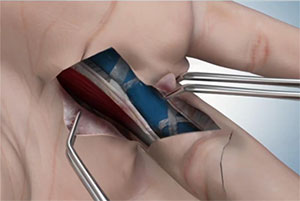
Dupuytren’s disease is a progressive hand condition that causes thickening of the connective tissue beneath the skin of the palm. Over time, this thickened tissue may form cords that pull the fingers inward, limiting hand function. Treatment focuses on preserving finger motion and correcting contracture when necessary.
At SCOS, our orthopedic and hand specialists provide comprehensive Dupuytren’s disease evaluation and treatment for patients throughout Orange County, including Irvine, Huntington Beach, Fullerton, Newport Beach, Costa Mesa, Mission Viejo, Laguna Niguel, Yorba Linda, Placentia, and Anaheim.
If you have noticed thickened tissue in your palm or difficulty straightening your fingers, early evaluation can help determine the most appropriate treatment approach.
What Is Dupuytren’s Disease?
Dupuytren’s disease is a chronic condition that affects the fascia — the connective tissue layer beneath the skin of the palm. As the fascia thickens and tightens, nodules and cords may form, eventually causing one or more fingers to bend toward the palm. This bending is known as Dupuytren’s contracture.
The disease typically progresses slowly and most commonly affects the ring and small fingers.
What Are the Symptoms of Dupuytren’s Disease?
Symptoms may include:
- Thickened nodules in the palm
- Firm cords under the skin
- Gradual finger bending
- Difficulty placing the hand flat on a surface
- Reduced grip function in advanced cases
The condition is often painless but can interfere with daily activities as it progresses.
What Causes Dupuytren’s Disease?
The exact cause is not fully understood, but several risk factors have been identified:
- Family history of Dupuytren’s disease
- Age over 50
- Male gender
- Northern European ancestry
- Diabetes
- Smoking and alcohol use
Dupuytren’s disease is not typically caused by repetitive hand use or trauma.
How Is Dupuytren’s Disease Diagnosed?
Diagnosis is usually made during a physical examination. Your orthopedic specialist will:
- Assess nodules and cords in the palm
- Measure finger contracture angles
- Evaluate hand function
Imaging studies are rarely required unless other hand conditions are suspected.
What Are the Treatment Options for Dupuytren’s Disease?
Treatment depends on disease severity and functional limitation.
Observation
In early stages without significant contracture, monitoring may be recommended.
Minimally Invasive Treatments
For progressive disease with functional limitation, options may include:
- Collagenase injections to weaken and dissolve cords
- Needle aponeurotomy (percutaneous release) to divide the cord
These procedures are typically performed in the office with minimal downtime.
When Is Surgery Recommended?
Surgical treatment may be appropriate when:
- Finger contracture limits daily activities
- The finger cannot be straightened beyond a functional angle
- Minimally invasive treatments are not suitable
- The disease is advanced or recurrent
Surgery aims to remove or release diseased fascia to restore finger extension.
What Is Dupuytren’s Surgery?
The most common surgical procedure is a fasciectomy, which involves:
- Removing thickened fascia
- Releasing cords causing contracture
- Gradually restoring finger alignment
Surgery is typically performed on an outpatient basis. Postoperative hand therapy is often recommended to optimize recovery.
What to Expect During Recovery
Recovery varies depending on treatment type and disease severity.
Typical recovery considerations:
- Splinting after surgery
- Hand therapy to improve motion and strength
- Gradual return to normal activities
- Ongoing monitoring for recurrence
Full recovery may take several weeks to months.
What Are the Risks of Dupuytren’s Disease Treatment?
Although generally safe, potential risks include:
- Recurrence of contracture
- Stiffness
- Infection (rare with surgery)
- Nerve irritation
- Delayed wound healing
Your orthopedic specialist will discuss your individual risk profile and expectations.
What Are the Benefits of Treatment?
Treatment of Dupuytren’s disease can:
- Improve finger extension
- Restore hand function
- Reduce deformity
- Improve ability to grip and perform daily tasks
- Enhance overall quality of life
Early intervention may help preserve better long-term function.
Frequently Asked Questions
Is Dupuytren’s disease the same as Dupuytren’s contracture?
Dupuytren’s disease refers to the underlying condition. Dupuytren’s contracture describes the finger bending that develops as the disease progresses.
Does Dupuytren’s disease go away on its own?
No. It is typically progressive, although the rate of progression varies.
Can Dupuytren’s disease be cured?
There is no cure, but treatment can effectively improve finger position and function.
Is treatment painful?
Most minimally invasive treatments involve minimal discomfort. Surgical recovery may include temporary soreness and stiffness.
Why Choose SCOS for Dupuytren’s Disease Treatment in Orange County?
Our orthopedic hand specialists provide individualized care tailored to the stage of your disease and your functional goals. We offer both minimally invasive treatments and advanced surgical options when necessary.
Schedule an Evaluation
If you are experiencing progressive finger bending or thickened tissue in your palm, early evaluation can help preserve motion and prevent worsening contracture.
Contact our office today to schedule a consultation with an experienced orthopedic specialist in Orange County.

